
API Direct Connection vs iCal: What Actually Changes Day to Day
Both keep a calendar honest, and they are not the same job. An iCal link carries only open and blocked dates; a direct API connection carries availability, rate and order details both ways. This guide covers what each does, what breaks, and how you notice.
Both keep a calendar honest. They differ in what they can carry, how fast, and what it looks like when they fail.
Last updated: September 17, 2026
You have two ways to keep a channel's calendar in step with your own. One is an iCal link — the same calendar file format your phone uses. The other is a direct API connection built between the channel and your management tool. Sales pages present both as "sync," but they are not the same job. One carries dates and little else; the other carries your whole booking.
This article stays at the mechanism level: what each method can and cannot move, how quickly, and the failure signs that tell you which one is misbehaving. No polling intervals in milliseconds, no per-platform feature lists invented from memory — just the differences that decide whether you double-book.
Key Takeaways
- An iCal link carries only open and blocked dates — no prices, no guest names, no booking details, and no way to push a price change through it.
- A direct API connection carries availability, rate, and order details both ways, so a booking on one channel closes the night on all of them near-instantly.
- iCal is pulled on a schedule, not pushed, so a lag always exists between a booking somewhere and the block appearing elsewhere — the usual source of occasional double bookings.
- The API you need depends on channel count and how often you reprice, not on the size of your property.
- The two fail differently: iCal fails silently and stale; an API connection fails loud, with a sync-status flag you can actually see.
What an iCal link can and cannot carry
An iCal link is a calendar file. Your tool publishes a list of blocked and open dates; the channel reads that file and marks the same nights. That is the entire job. It works, and for a single listing on one or two channels it can be enough — but only if you accept three hard limits.
- It carries dates, nothing else. A night is either open or closed. The rate, the minimum stay, the cancellation terms, and the guest's name are not in the file.
- It cannot move a price. You change the rate in your tool, but the iCal feed has no field for it, so the channel keeps the price you last set there by hand.
- It is pulled, not pushed. The channel checks the file on its own interval, often a few minutes or more apart. A booking that lands in between those checks may not block the night elsewhere in time.
That lag is exactly why hosts on iCal-only setups occasionally get two guests for one night. The feed is not broken; it is just late. The fix is not a faster file — it is a different mechanism.
What a direct API connection adds
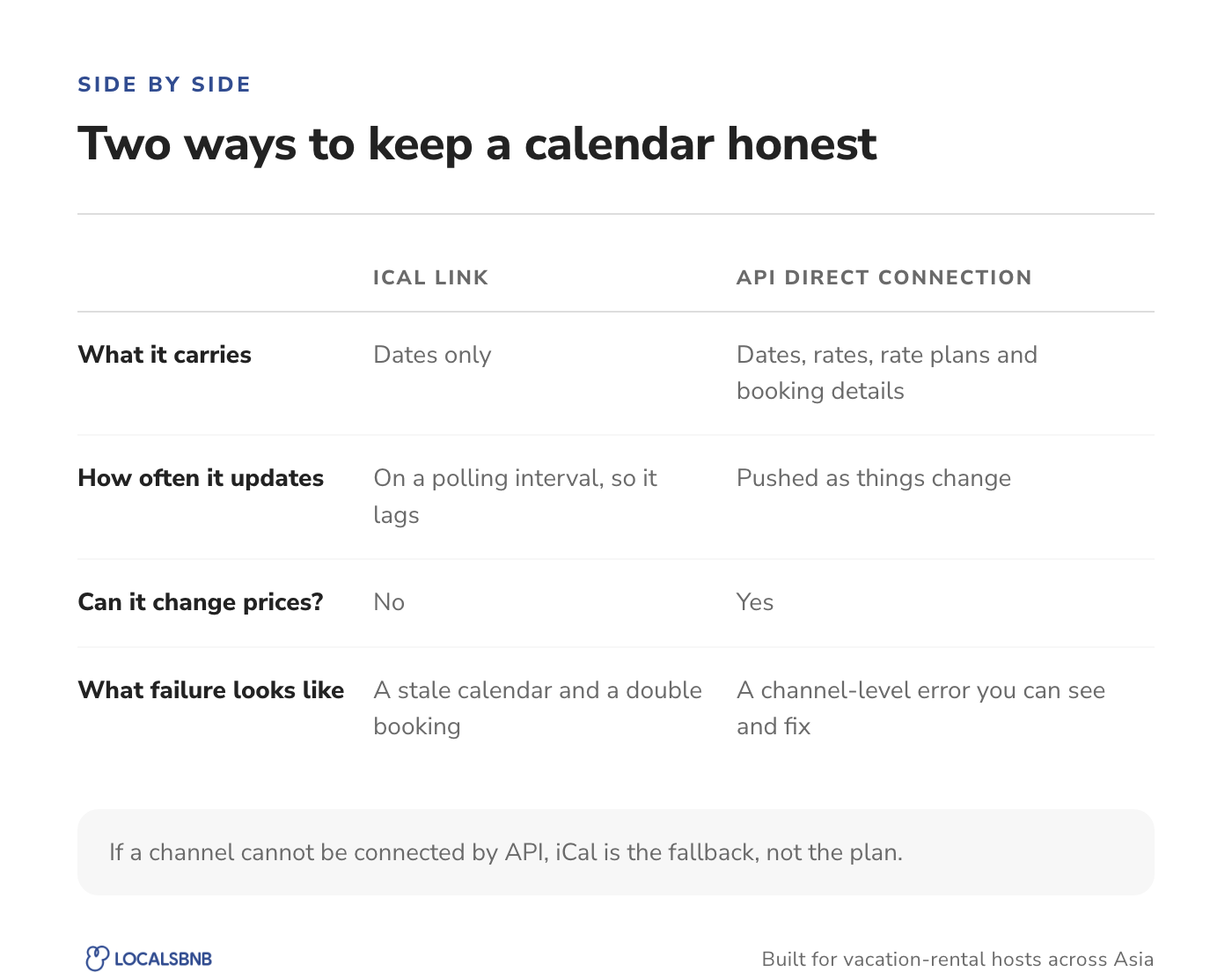
A direct API connection is a live two-way line between the channel and your tool. Instead of exporting a date list, it sends structured updates: availability, rate, restrictions, and the booking itself. The practical difference shows up in five places.
| What it carries | iCal link | Direct API |
|---|---|---|
| Availability (open / blocked nights) | Yes — dates only | Yes |
| Nightly rate | No — cannot carry or change price | Yes, both ways |
| Guest & booking details | No | Yes — order returns with names and dates |
| Two-way updates | No — one-way export, polled | Yes — push and pull |
| Speed | Delayed by polling interval | Near-instant |
With a direct API connection to Airbnb, Booking.com, Agoda, and Trip.com at localsbnb.com, price and availability move together the moment you edit them, and a reservation arrives with the guest's information already attached. How much more a connection carries beyond dates differs by platform — a Booking.com connection can exchange guest messages, while an Agoda connection does not return the guest's email by default, and Trip.com handles modifications on its own side. Those are platform behaviors, not a reason to avoid the API; they are simply what to expect when you read each channel's inbox.
Which one you actually need
The choice is not "big host uses API, small host uses iCal." It is about how many channels you run and how often your price moves.
- One listing, one or two channels, fixed weekly prices. An iCal link may serve you — as long as you manually keep rates matched and accept the small double-booking risk on busy nights.
- Two or more live channels with any overlap in dates. You need API sync. The moment two channels can sell the same night, a polled file is too slow to protect you.
- You reprice often or run seasonal rules. Only an API connection carries rate changes automatically; iCal will leave stale prices behind.
- You want bookings to arrive with guest details attached. API returns the order; iCal leaves you logging in to copy names by hand.
If you are unsure, assume API. The cost of iCal is paid in double-bookings and manual price fixes, usually after a guest is already unhappy.

What breaks, and how you notice it
The two methods fail in opposite ways, and the failure tells you which one is at fault.
- iCal fails silently. The feed stops updating, but nothing turns red. You notice only when a blocked night will not clear, or when two guests book the same date. The calendar looks fine right up until it isn't.
- An API connection fails loud. A sync error or a "last synced" timestamp that is hours old shows up in your channel manager. You see the problem before a guest does.
- Mixed setups hide the worst bugs. If one channel is on API and another on iCal, a price change lands on the API side and silently misses the iCal side — so the same room shows two prices on two channels.
A monthly check catches both: confirm a test block appears on every channel, and confirm a test price change reaches every channel that should carry it. If one channel needs a manual nudge, that channel is the weak link.
Self-check before you list or publish
- Am I running more than one channel that can sell the same night — and if so, is sync API-based, not iCal?
- Do my prices move after the first booking, or do I leave them fixed for weeks?
- When I change a rate, does it reach every channel, or only some?
- Can I see a "last synced" status for each channel, or am I flying blind?
- If a guest booked the same night twice, would I catch it before check-in?
- Have I tested one block and one price change across all channels this month?
Frequently asked questions
Is iCal good enough if I only have one listing?
For a single listing on one or two channels with fixed prices, iCal can work. The risk is the polling lag on busy nights and the fact that it cannot carry price changes — so you will be matching rates by hand.
Why did my price update on one channel but not another?
If one channel is on a direct API connection and another is on iCal, the rate change reaches the API side automatically but never reaches the iCal side, which has no field for price. That mismatch is the usual cause.
Does a direct connection stop all double bookings?
It removes the lag that causes most of them, because availability updates near-instantly both ways. It does not fix human error — a manually opened night or a wrong mapping can still double-book.
How do I know my sync is actually working?
Check the sync status in your channel manager and run a monthly test: block one night and change one price, then confirm both reached every channel. A channel that needs a manual nudge is your weak link.
Tired of guessing whether your calendar actually synced? Connect your channels by direct API at localsbnb.com.

Fees, rates, and platform policies change, so confirm current details with each channel before acting. Results vary by market, season, property type, and pricing. LOCALSBNB provides software, not financial or legal advice.
審核
Localsbnb 內容團隊